Skydiving Above the Statue of Liberty
By Greg Crozier
140 Years – 8 months – 20 minutes – 25 seconds
Two French World Champions, two American skydiving legends, eight months of preparation, and just 20 minutes to make history above one of the most iconic monuments on Earth.
On October 28, 2026, the Statue of Liberty celebrated its 140th anniversary. To honour this extraordinary symbol of freedom and the historic friendship between France and the United States, an international team of elite skydivers accomplished something that had long seemed almost impossible: an artistic freefall above Liberty Island, in the heart of New York Harbour.
Jump to the Story
- The Dream of an Almost Impossible Jump
- Getting Permission to Jump
- Twenty Minutes to Make History
- Who Made the Jump?
- Why Skydive Above the Statue of Liberty?
- More Than a Skydive: An Extraordinary Human Adventure
- From World Records to a Historic Landmark
- The Spirit of Jump for Liberty
- Keep Reading
The operation, named Jump for Liberty, brought together French skydiving World Champions Greg Crozier and Karine Joly, alongside two American skydiving legends, Jon Devore and Jeff Provenzano, both members of the Red Bull Air Force, with renowned aerial photographer and skydiver Ewan Cowie capturing the historic moment.
But behind the spectacular images lies a much bigger story: eight months of determination, diplomatic cooperation, military connections, extraordinary administrative challenges, and an unexpected level of human solidarity.
“The first-ever high-performance canopy to land at the foot of the Statue of Liberty was a JYRO LEIA.”
-
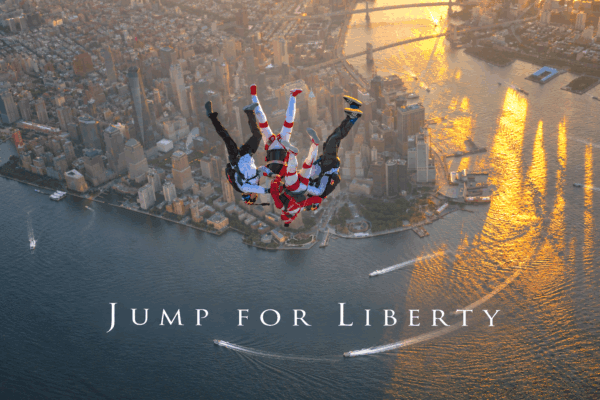
- 25 seconds above New York Harbor, eight months in the making. Photo: Ewan Cowie
The Dream of an Almost Impossible Jump
The Dream of an Almost Impossible Jump
The project was conceived, developed, financed and personally led by Greg Crozier, French skydiving World Champion, multiple world-record holder and reserve captain in the French Army.
Having completed more than 10,500 skydives across over 55 countries, including exceptional jumps above some of the world’s most famous landmarks, Greg had spent years imagining what it would take to organise a freefall above the Statue of Liberty.
For Greg and Karine, both French World Champions and military reserve officers, this was never intended to be an ordinary demonstration jump. It was a tribute to freedom, to the historic relationship between France and the United States, and to the values they represent as French athletes.
The timing was particularly meaningful: 2026 marked both the 250th anniversary of American independence and the 140th anniversary of the Statue of Liberty, France’s extraordinary gift to the American people. The ambition was simple to describe, but extraordinarily difficult to achieve.
Getting Permission to Jump
Organising a skydive above New York Harbour is nothing like organising a demonstration jump at a conventional drop zone. The Statue of Liberty sits at the intersection of some of the most complex and sensitive airspace, maritime and security environments in the United States.
The operation required coordination with the Federal Aviation Administration (FAA), including the three different airspace sectors involved in the planned flight, as well as multiple authorities responsible for the surrounding territories, aviation operations, maritime traffic and public safety.
The United States Coast Guard, the Port Authority of New York and New Jersey, local law enforcement and other relevant authorities all formed part of an exceptionally demanding coordination process.
Every detail had to be examined: helicopter operations, aircraft positioning, airspace restrictions, freefall trajectories, parachute deployment, maritime safety, landing procedures and emergency contingencies.
For eight months, Greg personally drove the project forward, maintaining contact with the different organisations, overcoming successive obstacles and refusing to abandon an idea that many considered unrealistic. One of the decisive breakthroughs came through his military connections in Washington, D.C.
With the exceptional personal involvement of Colonel Flavien Lanet, whose support proved instrumental in moving the project forward, the team was able to establish essential contacts and advance the discussions with American authorities.
This cooperation ultimately helped secure crucial assistance and the necessary security clearance involving the approval of the FBI, a remarkable development for a civilian skydiving project of this nature.
What had initially seemed almost unattainable gradually became possible through trust, persistence and cooperation between French and American partners. The French diplomatic network, including the French Embassy in Washington and the Consulate General of France in New York, also played an important role in supporting the Franco-American dimension of the initiative.
For Greg, the greatest challenge was not the freefall itself. It was bringing together all the different institutions and individuals necessary to make the operation possible.
Twenty Minutes to Make History
After eight months of preparation, the team was granted an exceptionally narrow operational window. Just 20 minutes.
Eight months of negotiations, planning, coordination and determination ultimately came down to a few minutes in which every element had to work perfectly.
The operation involved a helicopter flying in one of the most challenging aviation environments in the world, with New York City’s skyline, the Hudson River, New York Harbor and Liberty Island creating a spectacular but highly constrained setting.
There was no room for improvisation. The exit sequence, separation between skydivers, freefall formations, parachute openings and landing procedures all had to be carefully coordinated.
-
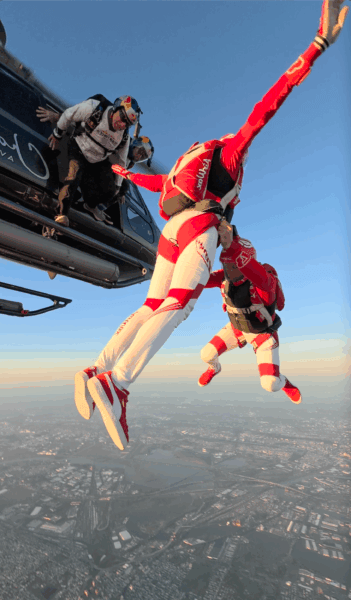
- Exit in one of the busiest airspaces on Earth. Photo: Ewan Cowie
For athletes accustomed to world-record formations and complex aerial performances, the technical aspects of the jump were familiar territory. But the environment made this operation completely different from a traditional skydiving event. The challenge was to combine world-class freefall precision with the extraordinary restrictions of an iconic urban and maritime location.
Who Made the Jump?
From the beginning, Greg and Karine wanted the jump to represent more than an individual sporting achievement.
Their intention was to bring together French and American athletes in the sky, celebrating the friendship between their two nations. They personally invited their longtime friends Jon DeVore and Jeff Provenzano, two internationally respected members of the Red Bull Air Force with whom they had shared world-record achievements and exceptional skydiving experiences over more than a decade.
-
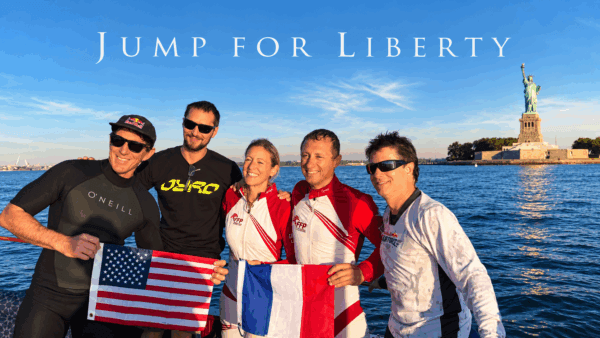
- Two French World Champions, two American legends, one flag each. Photo: Ewan Cowie
This was not a commercial demonstration organised or financed by a sponsor. It was an independent project initiated and developed by Greg and Karine, made financially possible thanks to the inheritance left by Greg’s grandfather. They chose to invest these personal funds in this extraordinary adventure and invited their longtime American friends to share this historic moment.
The fifth member of the airborne team was Ewan Cowie, an internationally renowned aerial photographer and skydiver, responsible for capturing the extraordinary images of the operation. Together, the five athletes combined decades of experience, thousands of skydives and an exceptional level of mutual trust.
That trust was essential to accomplishing such a demanding mission.
Who Made the Jump?
The Statue of Liberty is much more than a monument.
Standing at the entrance to New York Harbor, it has welcomed generations of immigrants and represented hope, democracy and freedom for people around the world. For French athletes, its significance is even more profound. Liberty is the first word of the French national motto: Liberté, Égalité, Fraternité.
-
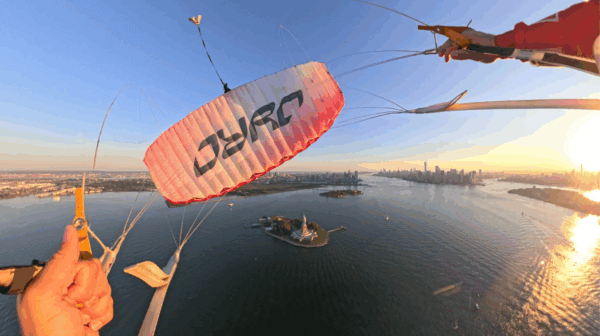
- Greg’s JYRO Leia, with Lady Liberty on the horizon.
Flying above this extraordinary monument, created through the friendship between France and the United States, carried a powerful emotional meaning. For Greg and Karine, representing their country as World Champions and French military reserve officers made the experience one of the greatest honors of their sporting careers.
The project was also a reminder that skydiving can achieve something beyond athletic performance: it can connect people, cultures and nations through shared values.
Why Skydive Above the Statue of Liberty?
What makes Jump for Liberty particularly remarkable is not simply the location or the technical difficulty.
It is the extraordinary chain of human relationships that made the project possible. Military officers, diplomats, aviation specialists, federal authorities, maritime professionals, pilots, skydivers and friends from both sides of the Atlantic contributed to transforming an almost impossible dream into reality.
Many of these people had no personal interest in the operation beyond their belief in its symbolic value and their willingness to help. For Greg, who had personally carried the project through eight months of challenges, this unexpected solidarity became one of the most powerful aspects of the adventure.
The final result was not simply the achievement of five athletes. It was the culmination of an exceptional collective effort, built around one man’s determination to create something meaningful and the willingness of others to help make it happen.
From World Records to a Historic Landmark
Greg Crozier and Karine Joly became World Champions together in Australia in 2018 and have spent much of their careers pushing the boundaries of artistic skydiving. Their experience includes numerous international titles, world records and extraordinary jumps in some of the most spectacular locations on the planet. Yet Jump for Liberty represented a completely different challenge.
There was no competition to win, no world-record formation to complete and no sporting medal waiting at the end. The achievement was to make possible a skydive that few people would ever have imagined could receive the necessary authorisations. After eight months of work, the actual freefall lasted only around 25 seconds.
Eight months of preparation for 25 seconds of freedom.
-
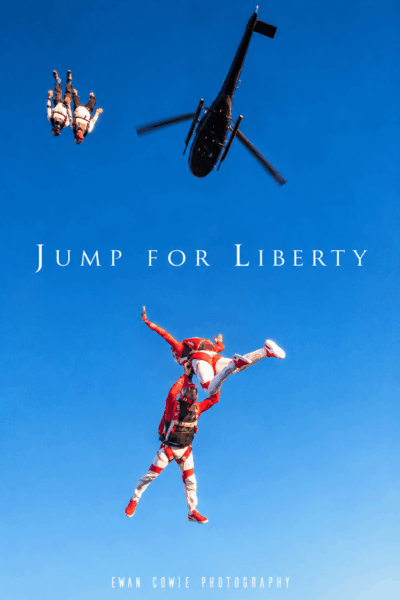
- One helicopter, 25 seconds, zero margin for error. Photo: Ewan Cowie
And perhaps that contrast best captures the spirit of Jump for Liberty.
The Spirit of Jump for Liberty
Jump for Liberty is ultimately a story about perseverance, friendship and the extraordinary power of human cooperation. It demonstrates that even in a world of complex regulations, security restrictions and administrative boundaries, exceptional projects can become reality when people share a common vision.
For Greg Crozier and Karine Joly, the images of their freefall above the Statue of Liberty will remain among the most meaningful of their careers. But the most important achievement may be what happened long before they boarded the helicopter: the determination to continue believing in a dream when almost every obstacle suggested it was impossible.
From France to America, from military cooperation to sporting friendship, Jump for Liberty became much more than a skydiving operation. It became a tribute to freedom, a celebration of Franco-American friendship and a reminder that extraordinary achievements begin with the courage to imagine the impossible.
Six months before the jump, Greg and Karine’s two American friends had agreed without hesitation to take part in this historic skydive. But they warned them:
“We’ll be there, but you’ll see—it’s never going to happen. We’ve been trying for years. Skydiving over the Statue of Liberty is impossible.”
Napoleon Bonaparte: “Impossible is not French.”
WATCH THE JUMP ON GREG’S IG:
Credits
Project creator and director: Greg Crozier
Athletes: Greg Crozier, Karine Joly, and Jeff Provenzano
Aerial photography and skydiving: Ewan Cowie
Keep Reading
Leia Review: A Wild Princess
Greg Crozier’s 10,000th Skydive Over Everest
AIRBUS 4-Way: 25 Years of Formation Skydiving
Meet the JYRO Athletes