Downsizing a skydiving canopy is an exciting step. But how do you know when you’re ready?
A smaller wing brings higher performance, faster speeds, and tighter margins, and those changes matter.
Before you make the move, it’s worth slowing things down and asking the right questions.
If you’re thinking about downsizing, start here.
It’s not just about how the wing flies, but how you think, plan and make decisions under canopy.
It’s about knowing when you’re ready, being honest when you’re not, and making decisions that lead to safer, more consistent flying you can rely on, now, and in the long run.
Why do I want to downsize?
Take the time to sit with this one and get real with yourself.
Are you downsizing because everyone else around is?
Because all the pros fly smaller wings?
Because it feels like the “next step”?
Have you received guidance from experienced canopy coaches who are familiar with your current skill set and canopy performance?
Are you consistently flying accurate, controlled patterns?
Identifying your motivation for downsizing, and whether it truly aligns with your long-term goals, matters more than the size on the warning label or the brag to your mates. Research into skill development consistently shows that progression is safest and most effective when it’s driven by competence, not comparison. Psychologist Anders Ericsson’s work on deliberate practice highlights that real advancement comes from mastering fundamentals with consistency before increasing difficulty. Similarly, Self-Determination Theory (Deci & Ryan) shows that decisions rooted in external pressure – keeping up with peers, chasing status, or copying role models – tend to undermine performance and judgment over time.
In canopy flight, the wing doesn’t care why you downsized. It only responds to inputs. Being honest about why you want more performance helps ensure your equipment choice supports learning, confidence, and longevity in the sport, rather than compressing the margin for error before your skills are ready to carry it. Downsizing should be a reflection of demonstrated capability, not a shortcut to it.
Do I have enough experience on my current canopy?
So you hit that jump number that your mate downsized at, and you’re ready to downsize. A story we’ve heard time and time again on the DZ. But a certain number of jumps does not equal experience. Experience is unique to every individual, dependent on their learning style, consistency and skills developed over time. Experience takes TIME. If you’re trying to improve your performance by downsizing, you’re missing the fundamentals and need to dedicate more time to improving your skills first.
Have you put in the time, repeatedly, to expand your skills and train hard?
Before moving to a smaller size, you should feel fully in control of your current canopy in all conditions. Ask yourself:
- Can I land accurately in varying winds?
- Am I comfortable with crosswind and downwind landings?
- Can I consistently judge traffic, altitude, and spacing?
- Have I explored the full control range of this canopy?
If there’s still more to learn where you are, that’s not a setback; it’s your foundation.
-

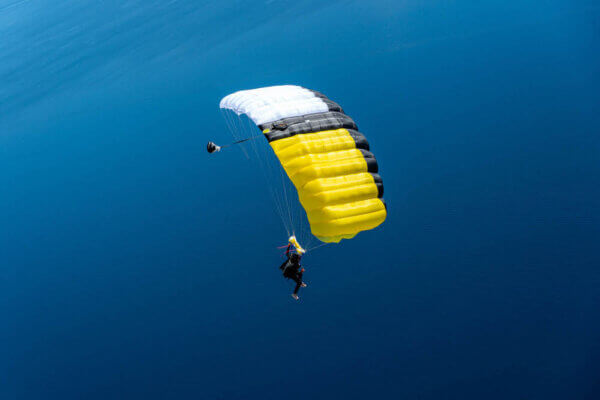
- Student Canopy cruising over water
What’s Wing Loading got to do with it?
Wing loading isn’t just a number on paper, and it isn’t the whole story, but it is one of the clearest indicators of how much performance (and risk) you’re choosing to manage right now.
As wing loading increases, so do:
- Stall speed
- Recovery arc
- Landing speed
- The speed at which mistakes develop
The only thing that decreases is your margin for error.
But wing loading alone doesn’t tell you how a canopy will behave. Canopy characteristics change with size as well as loading, and this is where many downsizing decisions go wrong.
For example, a Safire 4 149 will perform very differently for a 60 kg pilot than it will for a 100 kg pilot, simply because the wing loadings are different. Higher loading increases speed, reduces forgiveness, and shortens the time available to correct errors.
Now take it a step further. That same 60 kg pilot flying a Crossfire 3 89 at a wing loading of 1.5 will experience a very different canopy than a 100 kg pilot flying a Crossfire 3 149, also loaded at 1.5. Even though the numbers match, the wings do not. The smaller canopy has less span, less mass, and less inertia. It responds faster, recovers differently, and gives the pilot less time to recognise and fix a developing problem.
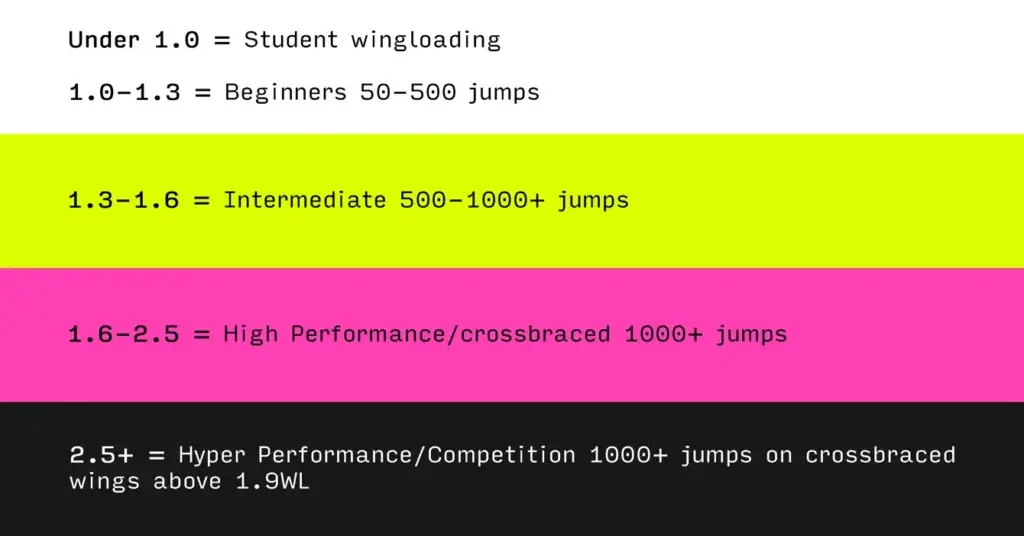
This is why “I’ll just match my wing loading” isn’t enough.
Knowing when to downsize means understanding what you’re actually changing when the canopy gets smaller – not just how fast it flies, but how quickly things happen and how much margin you have when they don’t go to plan. If you can’t clearly explain how your exit weight, canopy size, and model interact – and how that will affect your recovery arc, approach speed, and flare timing – you’re not just increasing performance. You’re compressing your decision-making window.
A higher wing loading doesn’t just mean faster flight.
It means faster consequences.
Do I understand what will change if I downsize?
Everything under canopy changes when you downsize, and wing loading is just one part of it.
It’s not a single decision. It’s a series of small, connected ones that all affect how you fly.
It’s shaped by where you’re at, how you’re flying right now, and where you want to go next. The canopy you’re currently jumping, your consistency, your currency, and your goals all play a part, and they should be considered together.
What type of wing are you moving to? Is it highly tapered (elliptical) or lightly tapered (semi-elliptical)? Cross-braced or non-cross-braced? A 7-cell or 9-cell design? Each of these choices changes how a canopy feels, how it responds to input, and how much feedback it gives you in the air. Understanding those differences is key.
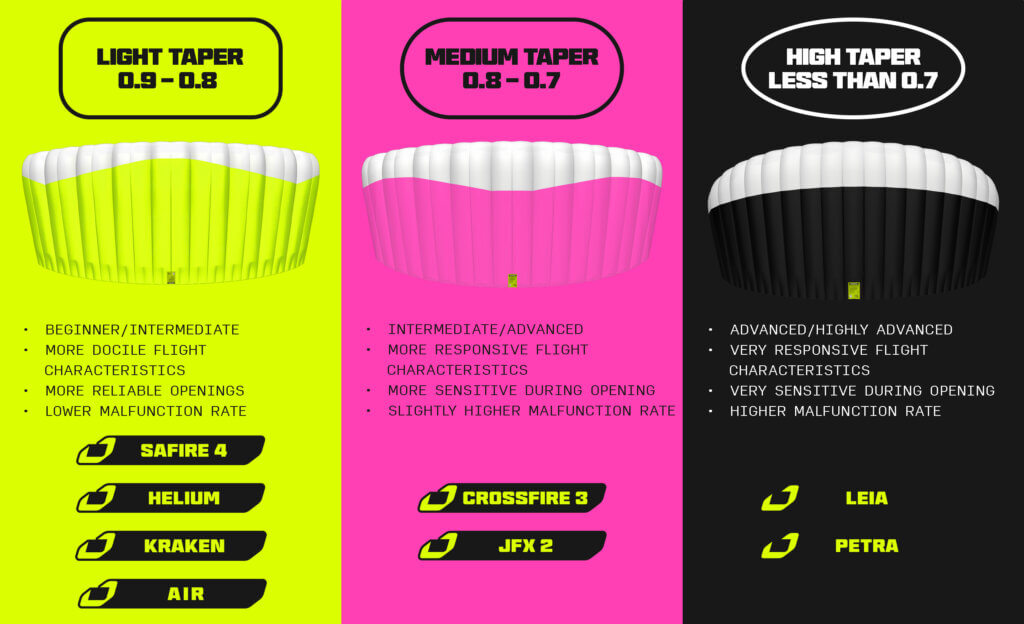
Then there’s size (and yes, size does matter). Any reduction in canopy size will increase performance, regardless of the model. Smaller wings are faster, more responsive, and less forgiving. Inputs are amplified, timing gets critical, and small errors that might go unnoticed on a larger canopy can quickly turn into bigger ones.
And sometimes, the smartest move isn’t downsizing at all. It’s upsizing.
>>Check out why here.
Downsizing should be intentional, not a box-ticking sign-off. If you’re trying to sense-check your next step, our Canopy Selector can help narrow things down based on experience, wing loading, and intended use.
>>DIVE IN: How to Choose the Right Canopy Size
Have I sought outside input from a trusted coach, DZO or instructor?
Self-assessment is valuable, and continually refining our abilities is part of the process. We’re also humans who jump out of planes, and that generally comes with an overdose of confidence (some might call it ego), or the opposite: being overly critical of ourselves.
It can go either way. Whether you’re feeling invincible or questioning every decision, it’s easy to miss the important details in the picture. That’s where a trusted coach, DZO, or instructor comes in bloody handy. A fresh set of experienced eyes can point out blind spots you didn’t even know were there, provide an objective perspective and help you decide if downsizing really is the right next move.
Yeah, outside input can feel like a brain fuck, but that’s the beauty of this sport. It’s a community, and we’re here to help each other make sustainable, safe calls.
-

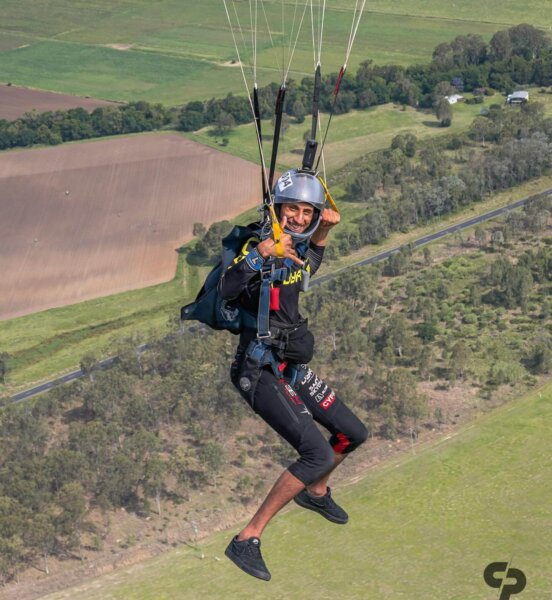
- JYRO Canopy Coach Zack Rosser. Photo Credit: Cam Putty
What’s my plan after I downsize?
There’s a big, wide world of JYRO canopies out there to work your way through (and of course, an equally diverse range of wings across the market). We get it. It’s exciting, it’s tempting, and it’s easy to want to try everything as soon as possible. But downsizing shouldn’t be the end goal. As much as we want you to progress through the JYRO range (or any canopy range) safely, the wing you’re flying deserves respect and appreciation for everything it offers at that size.
There’s no need to rush or expect an immediate jump in performance. Real progression comes from understanding a canopy deeply, not just flying a smaller one.
Before you downsize, ask yourself:
- Are you willing to take a back step, to relearn patterns on this new wing?
- Do I have conservative decision-making rules in place?
- Am I going to seek canopy coaching on this wing?
Long-term consistency and safety should be part of your plan.
-

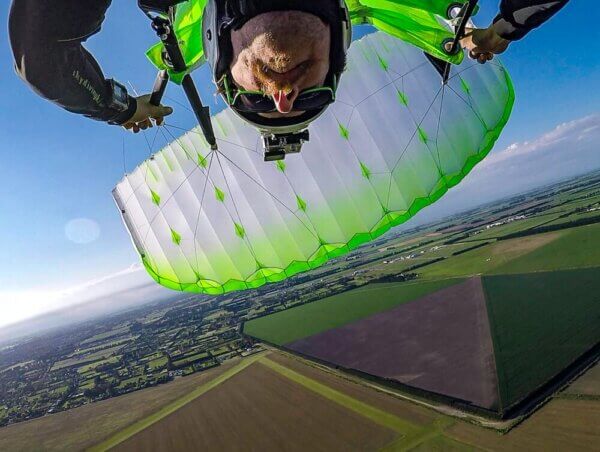
- Canopy Downsizing – do it slow and have fun!
If you’re serious about becoming a better canopy pilot, start building the habits now:
>>FLYING HABITS TO START FOR HIGHLY EFFECTIVE CANOPY PILOTS
>>25 WAYS TO BECOME A BETTER CANOPY PILOT
Progress isn’t a race
Every canopy you fly is teaching you something. Taking the time to fully absorb the lessons is what builds confident, capable canopy pilots. Downsizing done right can be rewarding. Done too early, it can remove options when you need them most.
Fly smart. Ask questions. There’s fun to be had, and there’s no prize for getting small fast. 😉
KEEP READING
Downsizing Checklist for Skydivers
The Canopy Progression Chart: Fly the JYRO Range
25 Ways to Become a Better Canopy Pilot
Buyer’s Guide: How to Choose the Right Canopy Size